About The Song
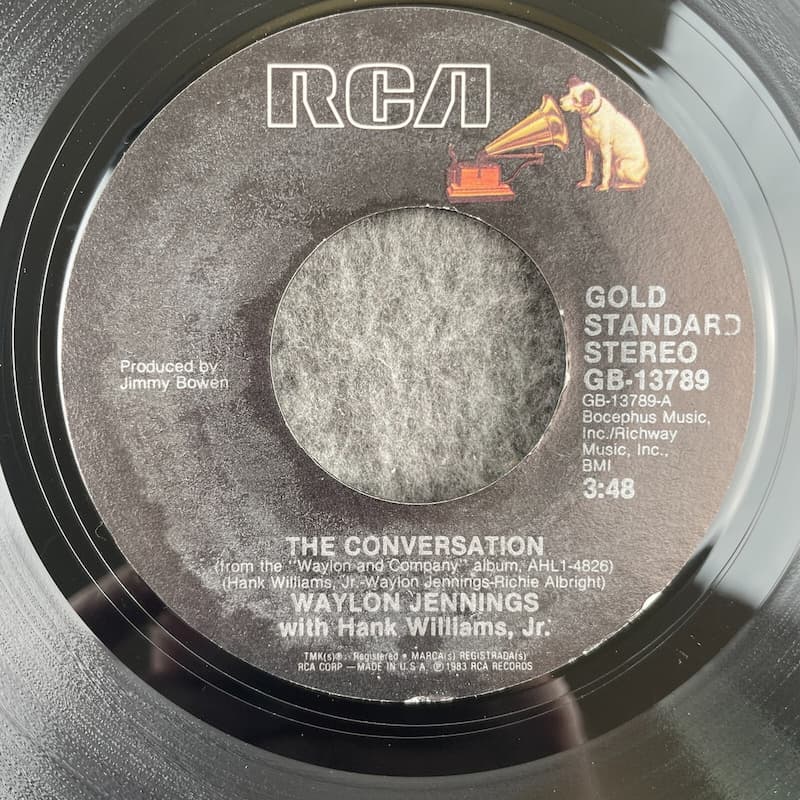
“The Conversation” is a duet recorded by Waylon Jennings with Hank Williams Jr., first appearing on Hank Williams Jr.’s 1979 album and later reissued by Waylon Jennings on his 1983 duet-focused album Waylon and Company. The version issued as a single from Jennings’s album was released in October 1983. Written by Waylon Jennings, Hank Williams Jr., and Richie Albright, the track stands apart as a compact, talk-like exchange between two major country figures who reflect on family, legacy and the shadow cast by Hank Williams Sr.
The song’s origin is rooted in the overlapping careers and personal histories of the two performers. Hank Williams Jr. had recorded an early version for his own record, and the piece later found a second life as part of Jennings’s duets project, which collected collaborations with various guest artists. The co-writing credit to Richie Albright—Jennings’s longtime drummer—reflects the collaborative, road-tested authorship behind the piece; the 1983 single was produced under Jennings’s artistic oversight and tracked with the straightforward production values favored in his late-period studio work.
Structurally, “The Conversation” is framed as a literal conversational exchange. Jennings assumes the role of questioner and listener while Williams Jr. answers in recollection, recounting details about his father, Hank Williams Sr., and the pressures of growing up with a famous name. The lyric relies on direct reportage and plainspoken lines rather than metaphor, and the narrative effect is one of immediacy: the performers speak rather than sing extended, metaphor-rich passages, which creates a sense of intimate candor and oral history within the song’s brief runtime.
Musically, the recording uses a lean country arrangement that keeps the focus on vocal interplay and the spoken-song delivery. Instrumentation is supportive and unobtrusive—electric and acoustic guitars, bass and restrained percussion—so that the words remain the central element. Jennings’s measured, conversational tone complements Williams Jr.’s more declamatory replies, and the production avoids heavy ornamentation so the piece reads as a short interview set to music rather than a conventional verse–chorus ballad.
When released as a single in late 1983, the duet achieved moderate commercial success on country radio. It climbed into the upper region of the Billboard country chart, peaking in the mid-teens, and it also registered on Canadian country listings. The single’s performance reflected both artists’ commercial standing at the time and the public interest in material that directly addressed the legacy of Hank Williams Sr., a subject that has consistently drawn listener attention in country music circles.
The release was also accompanied by a promotional music video, a relatively uncommon practice for country singles at that point, and the visual element helped broaden the recording’s exposure on television outlets that were beginning to feature country music programming. Over time the duet has been included on Jennings compilations and Williams Jr. anthologies and has been covered or referenced by later artists; it is often cited as a notable example of two established performers using a duet format to process personal and musical lineage.
In retrospective terms, “The Conversation” is best understood as both a documented exchange about familial legacy and a demonstration of the duet format’s capacity to convey spoken memory. It remains part of the recorded catalogs of Waylon Jennings and Hank Williams Jr., valued for its directness and for capturing a moment when two prominent country voices addressed the complexities of inheritance, fame and personal identity within a compact, plainly arranged musical setting.
Video
Lyric
Hank, let’s talk about your daddy
Tell me how your mama loved that man
Well, just break out a bottle, hoss
I’ll tell you bout the driftin’ cowboy band
We won’t talk about the habits
Just the music and the man, that’s all
Now Hank, you just got to tell me
Did your daddy really write all them songs? Did he?
That don’t deserve no answer, hoss
Let’s light up and just move along
Do you think he wrote ’em about your mama
Or about the man who done her wrong, you know that
Yeah, back then they called him crazy
Nowadays they call him a saint
Now the ones that called him crazy
Are still ridin’ on his name
Well, if he was here right now, Bocephus
Would he think that we were right? Do you think he might?
Don’t you know he would Watasha
Be right here by our side
If we left for a show in Provo
He’d be the first one on the bus and ready to ride, [Incomprehensible]
Wherever he is I hope he’s happy
You know I hope he’s doin’ well, yes I do
He is ’cause he’s got one arm around my mama now
And he sure did love Miss Audrey and raisin’ hell
I won’t ask you no more questions
To the stories only Hank could tell
[Incomprehensible]
Back then they called him crazy
Nowadays they call him a saint
Most folks don’t know that they fired him from the Opry
And that caused his greatest pain
I loved to tell you about lovesick
How Miss Audrey loved that man
You know I’ve always loved to listen
To the stories about that driftin’ cowboy band and the man
You know when we get right down to it
Still the most wanted outlaw in the land, yeah, woh