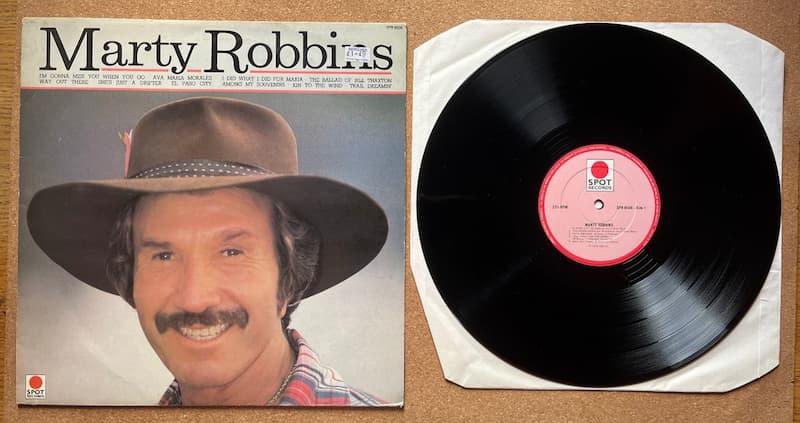
About The Song
“The Ballad of Bill Thaxton” is a western narrative song recorded by Marty Robbins and released in 1960 on his album More Gunfighter Ballads and Trail Songs. Issued by Columbia Records, the album continued the concept Robbins had established the previous year with Gunfighter Ballads and Trail Songs, focusing on concise story songs drawn from the mythology and moral landscape of the American West. Like most tracks on the album, the song was presented as an album cut rather than a standalone single.
At this point in his career, Marty Robbins had become closely identified with western storytelling. Rather than relying on traditional country love themes, he devoted entire albums to frontier characters and moral tales. “The Ballad of Bill Thaxton” fits squarely within this approach, offering a complete narrative built around a single character whose actions and fate are revealed through a brief but tightly structured lyric.
Lyrically, the song tells the story of Bill Thaxton, an outlaw whose violent reputation ultimately leads to his downfall. Robbins presents the tale in a straightforward, chronological manner, outlining Thaxton’s crimes, his notoriety, and the consequences he faces. The song avoids romanticizing the outlaw figure; instead, it frames Thaxton’s fate as inevitable, shaped by the choices he makes. This moral clarity is a recurring feature of Robbins’s western ballads.
Musically, “The Ballad of Bill Thaxton” is arranged in a restrained western style. Acoustic guitar provides the primary accompaniment, supported by subtle rhythm and minimal instrumental accents that heighten the sense of tension without distracting from the story. The tempo is measured, allowing the narrative to unfold clearly and giving each line room to land.
Marty Robbins’s vocal performance is calm and authoritative. He delivers the lyric with a storyteller’s restraint, resisting dramatic emphasis and letting the facts of the story carry the weight. This controlled delivery reinforces the song’s moral tone, presenting the ballad as an observation rather than a sensational account of violence.
Although the song did not chart as a single, it gained recognition through the continued popularity of More Gunfighter Ballads and Trail Songs. The album itself was well received and helped solidify Robbins’s reputation as the premier interpreter of western narrative songs. Tracks like “The Ballad of Bill Thaxton” contributed to the album’s cohesion and lasting appeal.
In retrospect, “The Ballad of Bill Thaxton” is regarded as a strong example of Marty Robbins’s disciplined approach to storytelling. Its concise structure, moral focus, and understated performance illustrate how Robbins transformed western archetypes into clear, self-contained narratives. The song remains a respected deep cut within his catalog and continues to appear on reissues and collections devoted to his influential western recordings.
Video
Lyric
Bill Thaxton was an ex ranger
One of the bravest by far
It’s said that old Bill was
The fastest man ever
To pin on a ranger’s star
Stories about him were legends
Bill was the best of the bold
Bad men all feared him way back in his day
But he was now growing old
Into Bill’s town rode an outlaw
He wore his gun low and tied down
He reined in his horse and
Announced to the crowd
“If you speak to me call me Sundown”
His clothes were all dark and fancy
And topped by a black leather vest
Somebody asked how he came by his name
And if he was one of the best
The eyes of the tall stranger narrowed
He grinned like the devil possessed
“I never fight till the sun’s going down
And my back is facing the West”
Said he wouldn’t be with us tomorrow
He only rode in for one thing
He only stopped by to make Bill Thaxton die
So he could add to his fame
“Go give Bill Thaxton a message
And tell him a killer’s in town
Tell him we’ll meet at the end of the street
Just as the sun’s going down”
Somebody said it had been years
Since old Bill had toted a gun
Sundown replied that it wasn’t his hide
Killing old Bill would be fun
The old ranger sent back his answer
“Tell him that I’m on my way
I’ve never ran and I’ll meet this young man
At any time of the day”
Bill got there just about sunset
It still hung like fire in the sky
In just a few moments out there in the street
Old Bill or the outlaw would die
Slowly Bill slid from the saddle
And started to make his advance
The sun hit the old ranger square in the eyes
The shadows had started to dance
Bill started talking to Sundown
Judging his distance that way
Their stride was the same and
At just thirty feet
Both of the men made their play
Bill’s gun slipped leather like lightning
His forty-four spoke with a whine
The sun didn’t bother Bill Thaxton at all
Because the old ranger was blind
Six shots delivered their message
The ranger had emptied his gun
Old Bill gave a sigh when there was no reply
He knew that once more he had won
The old ranger lowered his six gun
He just stood there starting ahead
Watching you’d think that old
Bill didn’t know
In front of him Sundown lay dead
Bill has been gone for a long time
But old timers still can recall
The day the old ranger stood up to the test
And proved he was best of them all