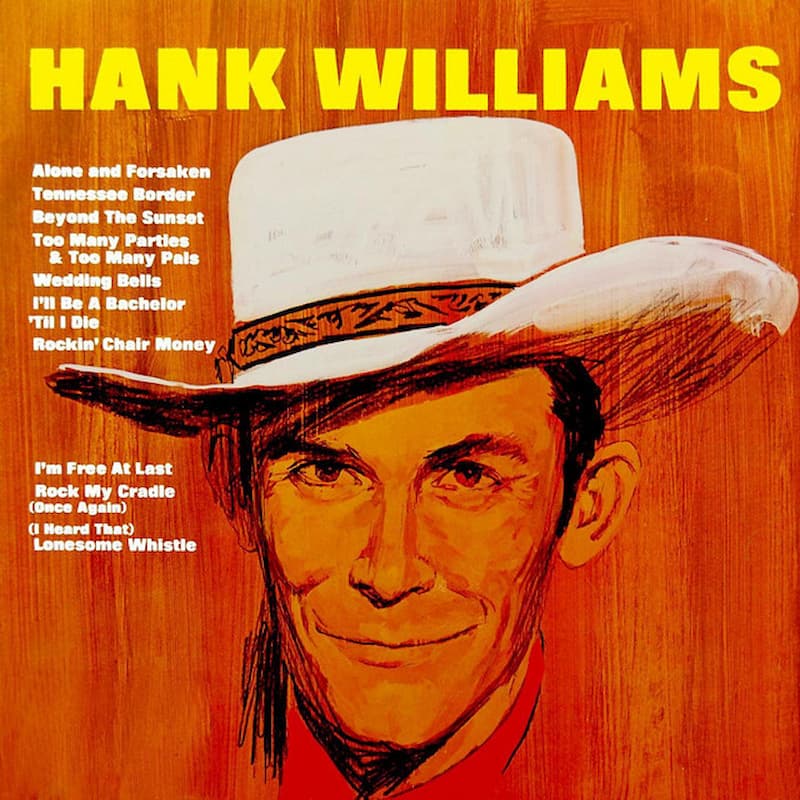
About The Song
“Tennessee Border” sits in an interesting place in Hank Williams’s catalog: it is a recognizable title from his MGM years, but not one of the songs most casual listeners use to define him. The composition is generally credited to Zeke Clements, with additional publishing-era credits appearing in some catalogs, and it circulated in the late-1940s country market when “state-line” romance songs were commercially reliable radio material. Hank recorded his version in 1949, during the same intense period when he was cutting both major hits and strong secondary singles for MGM. That context matters, because this was part of a high-output phase rather than a one-off recording.
For release framing, the song is usually documented as a 1949 Hank Williams single, then reissued on later compilations instead of being tied to one definitive original LP-era album cycle. That is common for late-1940s country records: first life as 78 rpm and radio play, second life through compilation albums assembled years later. If you are writing for readers who expect modern album logic, it helps to explain that many Hank titles were “single-first” products, and album attachment often came afterward through label repackaging. In practical listening history, fans discovered this track through both original single circulation and later archival collections.
The storyline is straightforward and radio-friendly: romantic pursuit set around a geographic boundary, using the “border” image as both place and emotional device. This is exactly the kind of narrative country songwriting that functioned well in short broadcast slots—immediate premise, clear stakes, no ornamental language. Hank’s vocal delivery, especially in this period, tends to keep the song grounded: clipped phrasing, direct diction, and a balance between conversational tone and melodic control. That performance style is a key reason even less-celebrated singles from his catalog still feel historically useful when tracing the craft of postwar country vocals.
Industry-wise, the track belongs to the same commercial ecosystem that produced multiple competing recordings of the same song. “Tennessee Border” became strongly associated with Red Foley as well, and that overlap helps explain why attribution can blur in public memory. In the late 1940s and early 1950s, different artists often cut the same title for different labels, with regional radio and jukebox play deciding which version dominated a given market. So when discussing Hank’s take, it is more accurate to frame it as part of a competitive song marketplace rather than a single definitive ownership story.
On Billboard history, you should be careful with absolute claims unless you are looking at the exact chart archive entry for the specific artist/version. Hank Williams’s biggest chart legacy is anchored by other titles that clearly peaked at or near the top of country charts, while “Tennessee Border” is usually treated as a notable catalog recording rather than his signature Billboard milestone. For a factual blog post, the safest editorial approach is: acknowledge its place in his 1949 output, note its broader multi-artist life, and avoid overstating a chart peak that may belong to another performer’s version.
What makes this song worth revisiting today is not mythology but documentation value: it shows how Hank worked inside the professional Nashville-country system before every recording had a modern album narrative attached to it. It also reveals how songs traveled in that era—writer to publisher, publisher to multiple artists, artist to regional radio, then later to anthologies that rewrote public memory. If your goal is depth without sentimentality, “Tennessee Border” is a strong example of how a mid-tier single can still illuminate the mechanics of classic country at a high level.
Video
Lyric
Her eyes were blue, her hair was auburn
Her smile was like an angel fair
She was her daddy’s only daughter
On the Tennessee border
One night I took a ride just across the line
I picked her up in a pickup truck and she broke this heart of mine
Her mama said, “No, she’s my only daughter”
But we got married on the Tennessee border
The roses were bloomin’ there on the border
The moon was shinin’ there
Her personality made me want her
On the Tennessee border
One night I took a ride just across that line
I picked her up in a pickup truck and she broke that heart of mine
Her mama said, “No, she’s my only daughter”
But we got married on the Tennessee border
One night I took a ride just across the line
I picked her up in a pickup truck and she broke this heart of mine
Her mama said, “No, she’s my only daughter”
But we got married on the Tennessee border