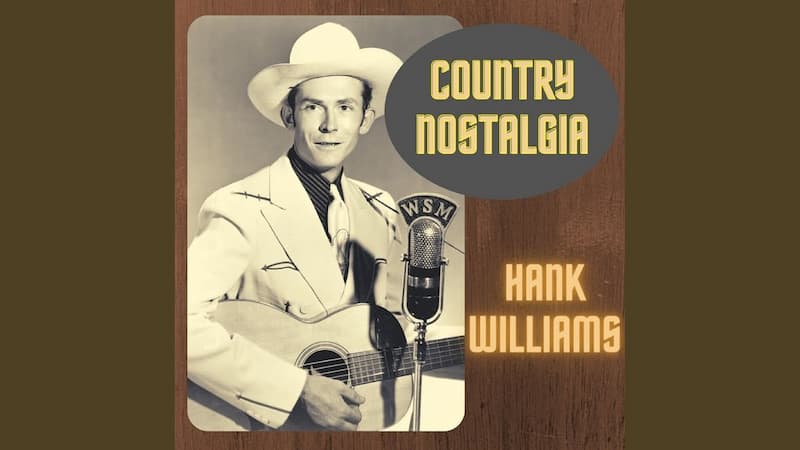
About The Song
“Where the Soul Never Dies” is one of the best examples of how Hank Williams connected commercial country audiences with older gospel material that already had a long life in churches and hymn traditions. The song itself was not written by Hank; it is generally credited to William M. Golden, with roots in early 20th-century evangelical songwriting. By the time Hank recorded and performed songs like this, the piece was already established in Southern sacred repertoire. That distinction is important for accurate history: Hank’s contribution was interpretation and transmission, not original authorship.
In Hank Williams’s catalog, this title is most often associated with his gospel output and with the body of recordings linked to the Drifting Cowboys and, in broader public memory, the Luke the Drifter-era religious persona. As with many recordings from the late 1940s and early 1950s, release history can be complicated: songs frequently appeared as singles, radio performances, or later compilations rather than through one modern album rollout. For blog writing, the most reliable framing is that Hank helped popularize this hymn for country listeners during his peak MGM years, and later reissues cemented its place in his legacy collections.
The lyric content is direct and theological: earthly struggle is temporary, while permanent peace exists “where the soul never dies.” What made the song durable across generations is its clarity. It does not rely on narrative twists or poetic ambiguity; it presents doctrine in plain language that congregations could sing together and solo artists could adapt. That flexibility explains why the song moved easily between church services, radio gospel segments, and country performance circuits. In technical terms, it is built for communal memory: simple melodic movement, repeatable refrain logic, and vocabulary that survives outside specialist contexts.
Hank’s role in songs like this also reflects a larger industry pattern. Mid-century country artists regularly balanced secular heartbreak material with sacred repertory, partly for audience expectation and partly because regional performance culture treated both as part of the same musical life. A Saturday-night honky-tonk set and a Sunday gospel broadcast were not separate worlds for many listeners. When Hank recorded sacred songs, he was operating inside that cultural system, and his vocal style—economical phrasing, emotional restraint, clean diction—fit gospel texts that required credibility more than ornament.
For Billboard discussion, this title is usually not cited as one of Hank Williams’s defining country-chart milestones in the way his biggest secular hits are documented. The stronger historical claim is influence rather than peak chart ranking: the song became part of the enduring gospel-country songbook and remained active through later covers, bluegrass circuits, and heritage compilations. If you need strict chart precision in your blog, verify the exact Billboard entry by version and release date before naming a peak position. That approach protects factual accuracy and avoids importing chart data from different recordings with similar titles.
A useful side story for readers is attribution drift: audiences often assume songs in Hank’s gospel orbit were written by him because his performances are so closely identified with the material. “Where the Soul Never Dies” shows why historian-level writing should separate composer, arranger, and popularizer. Golden represents the songwriting source; church and quartet traditions represent transmission; Hank represents mid-century country amplification. Presenting all three layers gives your article depth, keeps the tone natural, and remains faithful to the documented history of American gospel-country crossover.
Video
Lyric
To Canaan’s land I’m on my way
Where the soul of man never dies
Where the soul, never dies
My darkest night will turn to day
(Where the soul of man never dies)
Where the soul, never dies
Dear friend there’ll be no sad farewells
(No sad farewells)
There’ll be no tear-dimmed eyes
(No tear-dimmed eyes)
Where all is joy, peace and love
{Where all is joy)
And the soul of man never dies
(And the soul never dies)
A garden’s blooming there for me
Where the soul of man never dies
(Where the soul never dies)
And I shall spend eternity
Where the soul of man never dies
(Where the soul never dies)
A love-light beams across the foam
Where the soul of man never dies
(Where the soul never dies)
It shines to light the fires of home
Where the soul of man never dies
(Where the soul never dies)
My life will end in deathless sleep
Where the soul of man never dies
(Where the soul never dies)
And everlasting joys I’ll reap
Where the soul of man never dies
{Where the soul never dies)
I’m on my way to that fair land
Where the soul of man never dies
(Where the soul never dies)
Where there will be no parting hand
Where the soul of man never dies
(Where the soul never dies)