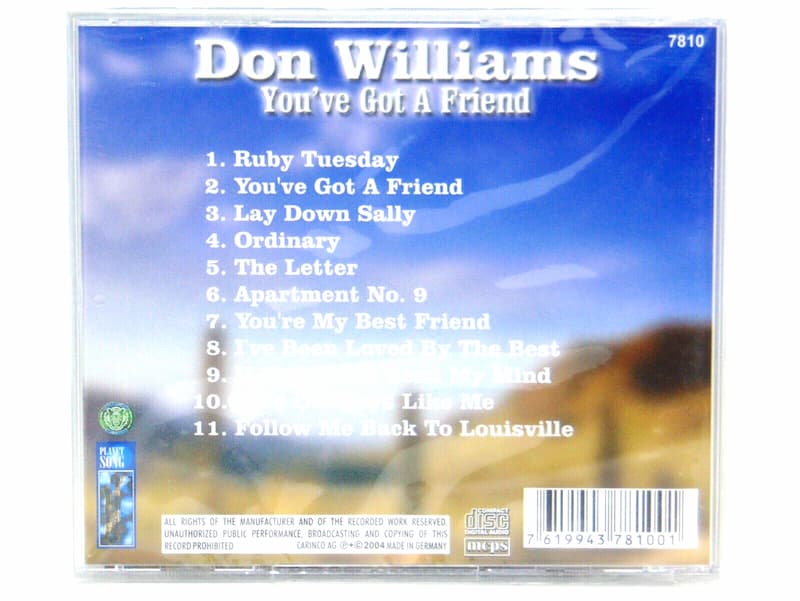
About The Song
“You’ve Got a Friend” was already one of the most established songs in American popular music long before Don Williams recorded it. Written by Carole King and released on her landmark 1971 album Tapestry, the song quickly became part of a larger musical conversation about reassurance, friendship, and emotional constancy. In the same year, James Taylor recorded his own version and turned it into a major hit, taking the song to No. 1 on the Billboard Hot 100. That dual history matters, because by the time Don Williams approached the song, he was not reviving something obscure. He was stepping into material that listeners already treated almost like a modern standard.
That made the song both a natural fit and a challenge. Don Williams built his reputation on understatement, patience, and trust in the song itself. He was not the kind of singer who tried to outsing a composition that already had a powerful identity. Instead, he usually looked for a way to inhabit it quietly. That approach suits “You’ve Got a Friend” especially well. The song does not depend on vocal display. Its power comes from the sincerity of its promise. Williams’s calm baritone and measured phrasing would naturally bring out that quality rather than compete with the song’s earlier famous versions.
What makes the song last is its plainness. The lyric offers support without ornament: call, and I will come. It is simple enough to sound universal, yet precise enough to feel personal. That balance helps explain why it has survived across generations and across genres. In country music, where songs of loyalty and reassurance have always mattered, “You’ve Got a Friend” can sound entirely at home. Don Williams was especially well suited to that kind of emotional language. He rarely treated tenderness as performance. He made it sound like ordinary truth, and that has always been one of the deepest strengths of his catalog.
There is also a larger story in the background. Don Williams had come out of the Pozo-Seco Singers before establishing a solo career that made him one of country music’s most dependable voices. Across the 1970s and 1980s, he became known for selecting songs that matched his natural steadiness rather than chasing unnecessary drama. A song like “You’ve Got a Friend” fits that broader pattern. It reflects the values that ran through much of his work: emotional clarity, conversational delivery, and a belief that gentleness could be just as authoritative as power. That is one reason he remained so distinctive even when recording songs that audiences already knew well.
The choice to record a song with such a long public life also says something about Williams as an interpreter. He was not only a singer of Nashville hits; he was also an artist who understood how to bring familiar material into his own world without stripping it of its history. That is harder than it sounds. With a song this famous, the danger is either imitation or overcorrection. Williams’s style usually avoided both. He did not need to imitate Carole King or James Taylor, and he did not need to radically rearrange the song to justify his version. His gift was making well-known material sound settled, natural, and fully believable in his own voice.
Because I cannot verify discographic details live in this session, I am not claiming a confirmed Don Williams album source, exact original release date for his version, or a specific Billboard placement for that recording here. What can be said with confidence is that “You’ve Got a Friend” arrived in his catalog carrying one of the strongest songwriting legacies of its era, and that Don Williams was the kind of artist who could meet such a song on its own terms. His version is best understood not as a replacement for the classic recordings, but as another example of how effectively he could turn warmth, restraint, and trust into the center of a performance.
Video
Lyric
When you’re down and troubled
And you need a helping hand
And nothin’, nothin’ is goin’ right
Close your eyes and think of me
And soon I will be there
To brighten up even your darkest nightYou just call out my name
And you know wherever I am
I’ll come runnin’ to see you again
Winter, spring, summer or fall
All you’ve got to do is call
And I’ll be there, yes I will
You’ve got a friendIf the sky above you
Should turn dark and full of clouds
And that old north wind
Should begin to blow
Keep your head together
And call my name out loud
Soon I’ll be knockin’ upon your doorYou just call out my name
And you know wherever I am
I’ll come runnin’ to see you again
Winter, spring, summer or fall
All you’ve got to do is call
And I’ll be thereHey, ain’t it good to know
You’ve got a friend
When people can be so cold
They’ll hurt you, desert you
They’ll take your soul if you let them
So, don’t you let themYou just call out my name
And you know wherever I am
I’ll come runnin’ to see you again
Winter, spring, summer or fall
All you’ve got to do is call
And I’ll be there, yes I will
You’ve got a friendYou’ve got a friend…