About The Song
“Looking Back to See” is one of those country songs that already had a full life before Buck Owens and Susan Raye ever sang a note of it. The writing is credited to Jim Ed Brown and Maxine Brown, and the title has long been associated with the classic duet tradition—two voices trading a simple, human idea that feels like it came from a real moment instead of a writer’s room.
Long before the Bakersfield crowd claimed it, the song was already moving through Nashville. Industry reference books from the period list early recordings by The Browns in 1952 and by Justin Tubb and Goldie Hill in 1954. That’s an important breadcrumb: Justin was Ernest Tubb’s son, and Goldie Hill was already a proven duet partner and solo hitmaker, so the tune entered the world through the “working Opry / Decca” lane—songs built for jukeboxes, radio, and two people telling the same story from slightly different angles.
By 1972, Buck Owens had become the most recognizable voice of the Bakersfield sound, but he also loved pulling older country titles forward when they fit his instincts. Susan Raye, meanwhile, had become part of his inner circle as a Capitol labelmate and touring partner. Their duet brand was already established through earlier hits, so “Looking Back to See” wasn’t a random pairing—it was the kind of “known song” that let the chemistry do the selling without needing a new concept.
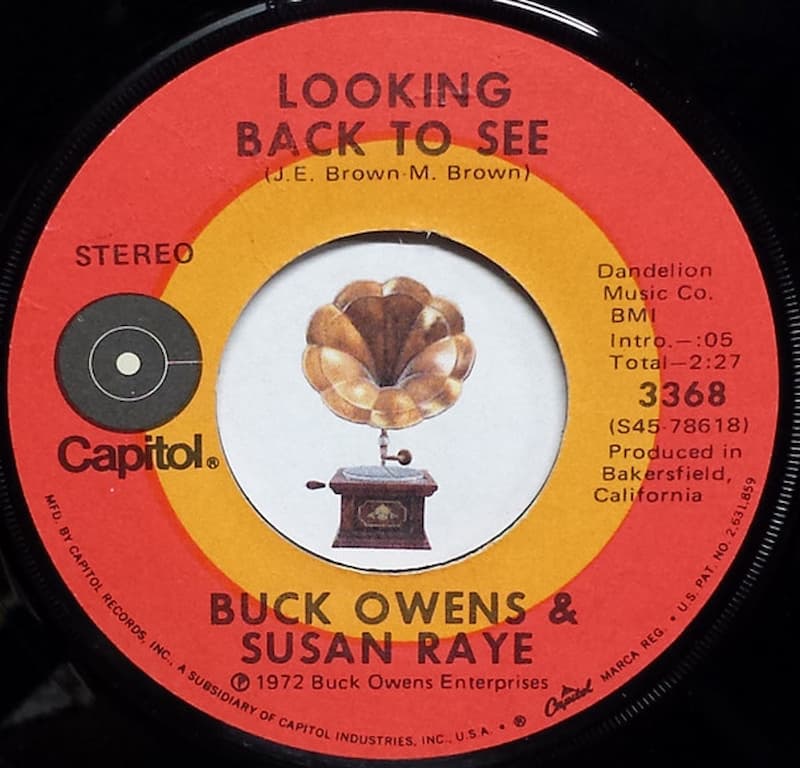
The Buck-and-Susan version was issued as a Capitol single in 1972, backed with “Cryin’ Time” on the B-side, and it was also tied to the compilation The Best of Buck and Susan. That combination tells you how Capitol viewed it: not a risky new direction, but a dependable record that could reinforce the duo’s identity while the label kept the pipeline moving. The way the 45 was packaged also fits the era—radio could ride the A-side, while fans who bought singles would immediately discover a second performance on the flip.
Chart-wise, it did exactly what a strong “pairing” record should do. “Looking Back to See” reached No. 13 on Billboard’s country singles chart, which put it in the middle of the duos-and-duets world Buck thrived in—records that weren’t always built to be crossover pop events, but were reliable country radio currency.
What’s easy to miss is how the song’s history and the performers’ careers line up. Buck’s whole public image was modern and sharp-edged for country—Telecaster bite, dance-hall rhythm—but he kept reaching back to earlier country storytelling when he wanted a record to feel timeless. Susan Raye’s clean delivery made that balancing act easier: she could stand beside Buck without being swallowed by the band, and the song’s structure gives each singer room to sound conversational rather than “featured.”
So “Looking Back to See” ends up acting like a bridge record. It carries the fingerprints of 1950s country duet culture (Tubb and Goldie Hill, The Browns) into a 1972 Capitol single, then lands inside the Buck Owens and Susan Raye partnership that fans already knew. The song didn’t need reinvention—just two familiar voices, a classic premise, and a label that understood that sometimes the smartest “new” release is an old song delivered by the right people.
Video
Lyric
I was looking back to see
If you were looking back to see
If I was looking back to see
If you were looking back at meYou were cute as you could be
Standing looking back at me
And it was plain to see
That I’d enjoy your companyOne Sunday afternoon
As I was ridin’ down the street
I met a cute little girl
All dressed up so sweetAnd the way that she was stacked
I wish I’d’ve had a Cadillac
But who would notice me
Just drivin’ my model TI was looking back to see
If you were looking back to see
If I was looking back to see
You were looking back at meYou were cute as you could be
Standing looking back at me
And it was plain to see
That I’d enjoy your companyNow listen, baby
It doesn’t matter to me
Even in your model T
You’re as cute as you can beIf you’ll take for a ride
I will sit close by your side
And I will guarantee
We’ll have fun oh man aliveI was looking back to see
If you were looking back to see
If I was looking back to see
You were looking back at meYou were cute as you could be
Standing looking back at me
And it was plain to see
That I’d enjoy your company(Oh me, oh gee)
Perhaps you’d notice me
If I wouldn’t drive this model TI was looking back to see
If you were looking back to see
If I was looking back to see
You were looking back at meYou were cute as you could be
Standing looking back at me
And it was plain to see
That I’d enjoy your company