About The Song
“Mule Skinner Blues,” originally known as “Blue Yodel No. 8,” stands as one of the foundational tracks in country music history. Jimmie Rodgers, widely regarded as the Father of Country Music and nicknamed the Singing Brakeman, wrote and first recorded the song on July 11, 1930, during a session at Hollywood Recording Studios in Los Angeles. The track captured Rodgers’ signature blend of yodeling, blues phrasing, and hillbilly storytelling, drawing from his experiences working on railroads and his deep appreciation for African American work songs and Delta blues.
The single was released on February 6, 1931, by Victor Records, paired with “Jimmie’s Mean Mama Blues” on the B-side. It was published shortly afterward by Southern Music Publishing. At the time, there were no formal Billboard charts in the modern sense, but the recording sold well enough to establish it as a hit for Rodgers, who had already built a national following through his earlier Blue Yodel series. The song later entered the public domain in 1959 after its copyright was not renewed.
Its roots trace back to earlier blues traditions. The opening lines and themes echo Tom Dickson’s 1928 recording “Labor Blues,” a raw work song about a laborer addressing his “captain” boss and struggling for fair pay. Rodgers adapted these elements, shifting the focus to a mule skinner—a driver who handled teams of mules hauling goods along muddy trails—and infused the piece with his distinctive yodel. George Vaughn, a pseudonym sometimes used for songwriter George Vaughn Horton, has been credited in later versions, though Rodgers remains the primary author.
The lyrics unfold as a straightforward narrative from the perspective of a down-on-his-luck worker. He approaches the captain with a polite “Good morning, captain,” inquires about a job on the “new mud line,” and boasts about his skills, claiming he can “pop my ‘nitials on a mule’s behind.” He requests a dollar and a half a day, calls for the water boy to bring water around, and ends with reflections on his personal life and romance. The structure follows a classic 12-bar blues form, delivered with Rodgers’ expressive voice and yodel breaks that added emotional depth to the tale of hard labor and resilience.
The song quickly spread beyond Rodgers’ version. Roy Acuff recorded it in 1939, helping popularize it among old-time country audiences. Bill Monroe, the Father of Bluegrass, performed it at his Grand Ole Opry debut on November 25, 1939, delivering such an energetic rendition that it prompted the first encore in the show’s broadcast history. Monroe recorded his own take in 1940 with the Blue Grass Boys and revisited it in 1950 as “New Mule Skinner Blues,” incorporating fresh lyrics by Horton that slightly altered the narrator’s romantic exploits while keeping the core work-song spirit intact.
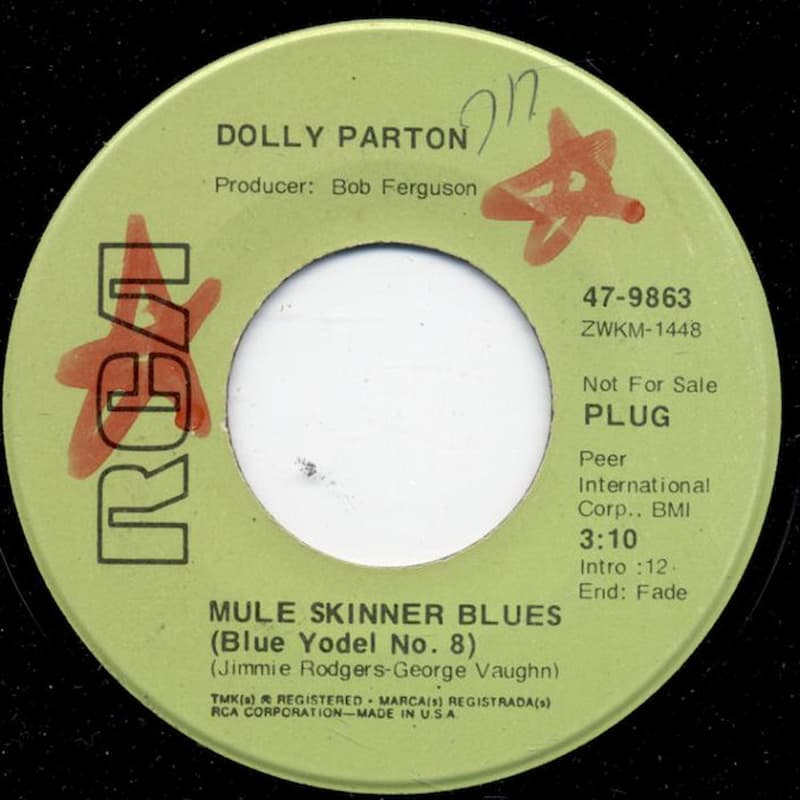
Decades later, the track found new audiences through diverse interpretations. In 1960, the Wisconsin rockabilly duo The Fendermen scored a surprise hit with an electric-guitar-driven version that reached number 5 on the Billboard Hot 100 and number 16 on the country charts. Dolly Parton brought it back to the country mainstream in 1970, recording a spirited take from a female perspective that climbed to number 3 on the Billboard country chart and earned her a Grammy nomination for Best Female Country Vocal Performance. She later performed it live with Monroe on a 1978 CBS television special celebrating fifty years of country music.
Over time, “Mule Skinner Blues” has endured as a bridge across genres and eras, appearing in folk revival recordings by Woody Guthrie in 1944 and influencing bluegrass standards. Its appearance in Ken Burns’ 2019 documentary series Country Music underscored its role in illustrating how a single “hillbilly” tune evolved alongside the music’s broader development. The song’s simple tale of labor, pride, and everyday struggle continues to resonate, with its history reflecting the intertwined paths of blues, country, and American folk traditions.
Video
Lyric
Wow, get on here
Well, good morning Captain
Good morning to you Sir
Hey, hey, yeah
Do you need another mule skinner?
Down on your new mud run
Hey, hey, yeah
Yodel-a-ee-he-he
He-he-he-he-he-he
Well, I’m a lady mule skinner from down old Tennessee way
Hey, hey, I come from Tennessee
I can make any mule listen or I won’t accept your pay
Hey, hey, I won’t take your pay
Yodel-a-ee-he-he
He-he-he-he-he-he, yeah
Well, hey, hey, little waterboy
Won’t you bring your water ’round?
Hey, hey
If you don’t like your job
Well, you can throw your bucket down
Throw it down boy, throw it down
Yodel-a-ee-he-he
He-he-he-he-he-he
Wow
I’ve been working down in Georgia
At a greasy spoon café
Hey, that lovely joint
Just to let a no good man
Draw every cent of my pay
Hey, hey and I’m sick of it
I wanna be a mule skinner
Yodel-a-ee-he-he
He-he-he-he-he-he
Yodel-a-ee-he-he
He-he-he-he-he-he
Mule skinner blues, yeah
Get out here, beautiful corpse, give me that