About The Song
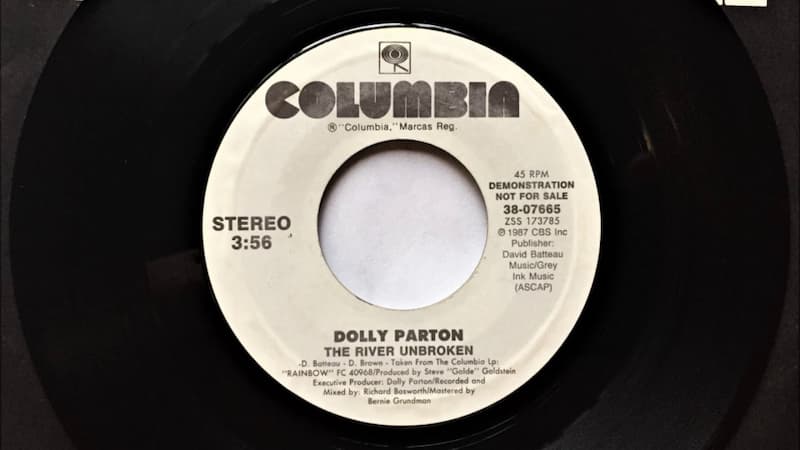
Released on November 23, 1987, as the lead single from her twenty-eighth solo studio album Rainbow, “The River Unbroken” marked Dolly Parton’s debut release on Columbia Records after leaving RCA. Written by Darrell Brown and David Batteau and produced by Steve “Golde” Goldstein, the three-minute-fifty-six-second track featured “More Than I Can Say” on the B-side. The album arrived the same day, recorded earlier that year in Los Angeles studios including Record One and Ocean Way, with Parton sharing production duties alongside Goldstein.
Rainbow represented Parton’s deliberate attempt to alternate between pop and country projects under her new label deal. The album leaned toward polished, contemporary arrangements rather than the rootsier sound of her earlier 1980s hits. Sessions included electric guitars, synthesizers, and layered backing vocals from Julia Waters, Maxine Waters, and Richard Dennison, creating a rootsy yet rock-flavored ballad that aimed for broader radio appeal. This stylistic shift followed years of crossover success but came at a time when Parton sought to refresh her commercial direction.
The single debuted on the Billboard Hot Country Songs chart at number 82 and climbed to a peak of number 63, spending eight weeks on the survey. It also reached number 43 on the Adult Contemporary chart, number 51 on the Canadian RPM Country Singles, and number 23 on the Canadian RPM Adult Contemporary chart. While modest by Parton’s standards, the performance reflected the album’s overall commercial challenges; Rainbow peaked at number 18 on the Top Country Albums chart and number 153 on the Billboard 200, marking one of her lower-charting projects to that point.
In the lyrics Parton sings of waiting for a train that never arrives, dreaming of a river and a rising sun while thinking about the world to come. The imagery evokes quiet perseverance and hope amid uncertainty, with the unbroken river serving as a central metaphor for steady forward motion through life’s changes. The message unfolds without heavy drama, relying instead on Parton’s warm soprano and the song’s flowing melody to convey a sense of patient longing and quiet resolve.
Critics offered mixed views on the track’s fit within the album’s glossy production. Billboard described it as a rootsy, rock-flavored ballad that could help regain pop stature, while Cashbox noted its countrified pop appeal and distinctive vocal but suggested it might disappoint hard country fans. A music video directed by Brian Grant accompanied the release, featuring Parton in a refined visual style that aligned with the album’s updated image.
The release stood as an early indicator of the challenges Parton faced during her Columbia period. Although the strategy of alternating styles was soon abandoned in favor of a return to more traditional country material, “The River Unbroken” illustrated her willingness to explore outside songwriters and contemporary production. The track later appeared on various compilations and remained a lesser-known but evocative entry in her catalog from the late 1980s.
Decades afterward the song serves as a reminder of a transitional chapter when Parton tested new creative boundaries. Its metaphorical depth and understated delivery captured the same honest emotional core that had defined much of her work, even as the broader album experiment highlighted the risks of shifting away from the sound that had built her audience.
Video
Lyric
Waiting for the train to come
I keep a waiting for the train to come
Dreamin’ of the river and the rising sun
I keep thinkin’ ’bout the world to come
My life packed up in a suitcase
Old man staring from a doorway
My hope tarries in the distance
Love comes on the wheels of my deliverance
Where is the river unbroken
When will the whistle blow
Waitin’ for the train to come
I keep waitin’ for the train to come
Keepin’ my appointment with the one who lives
In the heart of everything that is
All night sleepin’ in a station
My God, it’s hard not to be impatient
I watch through the windows of forgiveness
I cry but my word’s my only witness
Where is the river unbroken
When will the whistle blow
Where is the river unbroken
When will the whistle blow
Sometimes I feel I can’t go on, I can’t go on
I get so tired, all passion’s gone
My heart, my head, my arms, my legs, I get so tired
Then something breaks inside my soul, my strength is gone
That spirit’s finally taking hold
My ears can hear, my eyes can see
Those clouds of joy still cover me, cover me, cover me
Where is the river unbroken
When will the whistle blow
Where is the river unbroken
When will the whistle blow
Where is, where is the river unbroken
When will the whistle blow
Waiting for the train to come
I keep waiting for the train to come