About The Song
“At the Cross” is a traditional Christian hymn most commonly associated with the nineteenth-century writer and minister Isaac Watts, whose text originally appeared in 1707 under the title “Alas! and Did My Savior Bleed.” Long before Hank Williams ever sang it, the hymn had become a cornerstone of Protestant worship, especially in the American South, where it was frequently adapted into slower, more reflective gospel styles suitable for solo singing and small ensembles.
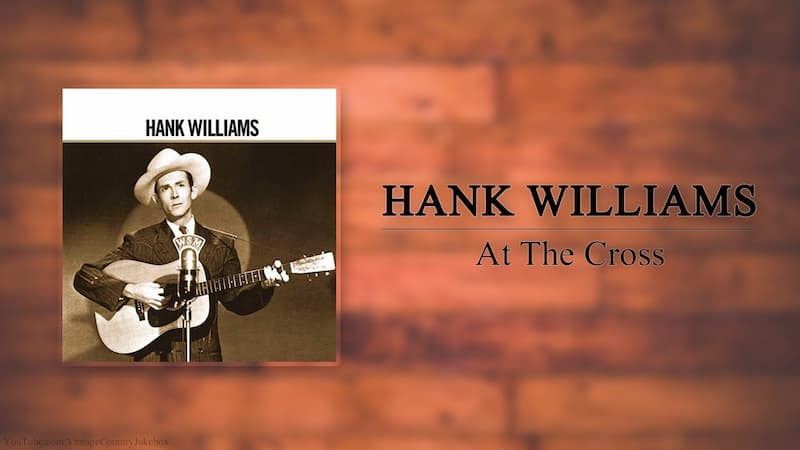
Hank Williams did not record “At the Cross” for release as a commercial MGM single. Instead, his known performances come from his radio and transcription work around 1949–1951, a period when he regularly included sacred material in programs such as the Mother’s Best and Health & Happiness shows. These recordings were made in Nashville studios for syndicated radio broadcast, capturing Hank in a more intimate, less commercial setting than his chart-oriented sessions.
In Hank’s hands, “At the Cross” becomes a plainspoken meditation rather than a formal hymn performance. His vocal delivery is restrained and unembellished, reflecting the way gospel songs were often sung in rural churches rather than on concert stages. The tempo is steady, and the melody is allowed to unfold without dramatic emphasis, placing the weight of the performance squarely on the meaning of the words rather than on musical display.
The arrangement used for Hank’s rendition is sparse, typically supported by light accompaniment from the Drifting Cowboys or minimal instrumentation appropriate for radio transcription. This stripped-down approach mirrors how Hank approached much of his sacred material: steel guitar and fiddle are present but subdued, functioning as atmosphere rather than lead voices. The result is a recording that feels closer to a devotional reading than a polished studio product.
Lyrically, “At the Cross” centers on personal reflection and humility, describing the moment of spiritual reckoning at the crucifixion and the emotional release that follows. These themes aligned naturally with Hank Williams’s own interest in gospel music, which often explored guilt, redemption, and moral reckoning. While his secular songs frequently addressed heartbreak and regret, his gospel recordings approached similar emotional territory through religious language.
Because the song was preserved through radio transcriptions rather than promoted as a single, “At the Cross” never appeared on Billboard charts under Hank Williams’s name. Its survival owes much to later archival releases and collectors who recognized the historical value of Hank’s radio performances. When these recordings were restored and issued decades later, they revealed how consistently he balanced commercial success with spiritual expression.
Today, Hank Williams’s version of “At the Cross” is best understood as part of his broader gospel legacy rather than as a standalone highlight. It demonstrates how deeply traditional hymns were woven into his musical world and how naturally he moved between honky-tonk storytelling and sacred reflection. For listeners exploring his non-commercial recordings, the song offers a quiet but revealing glimpse into the religious traditions that shaped both his music and his worldview.
Video
Lyric
Was it for crimes that I have done
He groaned upon on that tree
Amazing pity grace unknown
And love beyond degree
At the cross at the cross where I first saw the light
And the burden of my heart rolled away
It was there by faith I received my sight
And now I am happy all the day
Well might the sun in darkness hide
And shut his glories in
When Christ the mighty Maker died
For man the creature of sin
But drops of grief can never repay
The depth of love I owe
Here Lord I give myself to you
That all that I can do