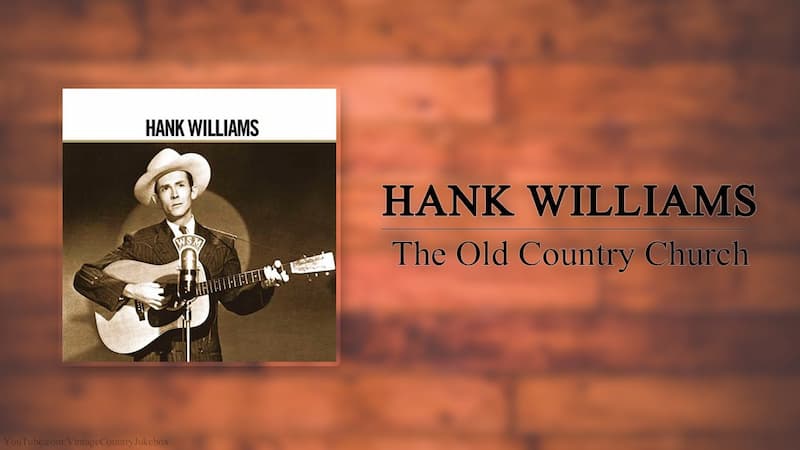
About The Song
“The Old Country Church” is one of the clearest windows into how Hank Williams carried church-rooted repertoire into mainstream country circulation. The song itself is older than Hank’s commercial rise and is generally credited to J. D. Vaughan, a major figure in Southern gospel publishing and singing-school culture. That background matters because it places the song in a living hymn tradition before it became associated with any one recording artist. By the time Hank performed and recorded material like this, audiences in the South already knew the theme: memory of a rural congregation, spiritual instruction, and community identity shaped through weekly worship.
In Hank Williams’s career timeline, this title belongs to the gospel side of his catalog rather than the honky-tonk singles that dominate popular retrospectives. Like many recordings from the late 1940s and early 1950s, it is most accurately understood through a single/radio/compilation pathway, not a modern “one album launch” model. Hank-era country commerce depended on 78-rpm releases, live broadcasting, touring, and later label repackaging. So when readers ask where the song “first appeared,” the careful answer is often: in performance and recording circulation first, then in post-period compilations that organized his sacred material for later audiences.
The lyric premise is direct and documentary in tone: a look back at a small church space as the center of moral education and social belonging. The song does not rely on abstract theology or elaborate poetic devices. Instead, it uses concrete details—people, place, routine—to show how faith is practiced in ordinary life. That simplicity is one reason the song survived beyond its original context. Congregations could sing it collectively, solo singers could personalize it, and country performers could adapt it without changing the core message. It is practical songwriting built for memory and repetition.
Hank’s interpretation style is especially relevant here. His phrasing tends to prioritize intelligibility over ornament, which helps narrative-gospel songs maintain credibility. In mid-century country performance culture, that mattered: listeners expected spiritual songs to sound sincere and grounded, not theatrical. Hank also operated in an ecosystem where secular and sacred repertoire coexisted naturally. The same artist could deliver heartbreak material for Saturday-night crowds and gospel songs for radio or Sunday settings. “The Old Country Church” fits that cultural pattern exactly, and that is part of why it remains historically useful when discussing Hank’s full artistic range.
Regarding Billboard context, this title is not usually treated as one of Hank Williams’s signature chart-defining peaks compared with his biggest country hits. The more accurate historical claim is repertoire importance rather than chart dominance. If you need a strict chart statement for publication, verify the exact song/version in Billboard archives before assigning any ranking. That caution is necessary because older gospel-country songs often exist in multiple recordings and later reissues, which can blur attribution when writers rely only on secondary summaries.
A valuable side angle for your blog is to present this song as evidence of transmission across systems: gospel publishing networks (like Vaughan’s), local church singing, commercial country recording, and finally archival compilation culture. That four-step path explains why attribution confusion appears in fan discussions and why some songs feel “owned” by performers who did not write them. In this case, J. D. Vaughan stands as the songwriting source, while Hank Williams remains one of the key interpreters who helped keep the song active in country memory. Framed this way, the article stays factual, natural, and historically deep without unnecessary sentiment.
Video
Lyric
All for pretty one called “The Old Country Church”
There’s a place dear to me, where I’m longing to be
With my friends at the old country church
There with mother, we went and our Sundays, we spent
With our friends at the old country church
Precious years (precious years) of memories (of memories)
Oh, what joy (oh, what joy) it bring to me (it bring to me)
How I long (how I long) once more to be (once more to be)
With my friends at the old country church
As a small country boy, how my heart beat with joy
When I looked in that old country church
And the savior above in His wonderful love
Save my soul at the old country church
Precious years (precious years) of memories (of memories)
Oh, what joy (oh, what joy) it bring to me (it bring to me)
How I long (how I long) once more to be (once more to be)
With my friends at the old country church
How I wish that today all the people would pray
As we prayed in that old country church
If they’d only confess, Jesus surely would bless
As He did in the old country church
Precious years (precious years) of memories (of memories)
Oh, what joy (oh, what joy) it bring to me (it bring to me)
How I long (how I long) once more to be (once more to be)
With my friends at the old country church
Oh, my thoughts make me weak for so many hours I weep
In that grave near the old country church
May I rest with my friends in that grave in the end
In the grave near the old country church
Precious years (precious years) of memories (sweet memories)
Oh, what joy (oh, what joy) they bring to me (they bring to me)
How I long (how I long) once more to be (once more to be)
With my friends at the old country church
Thank you all, that’s a pretty one