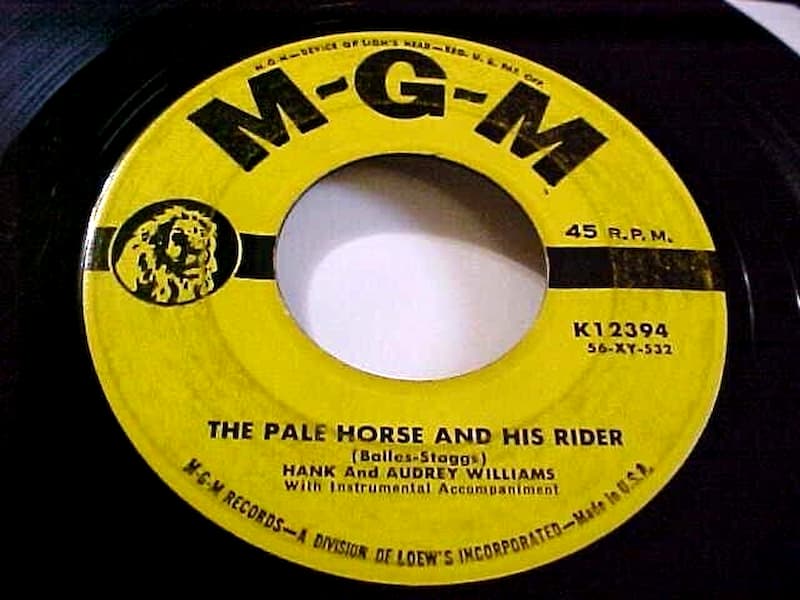
About The Song
“The Pale Horse and His Rider” is a country gospel song associated with Hank Williams’s sacred recordings rather than his commercial honky-tonk output. The song draws its imagery from the Book of Revelation, where the pale horse symbolizes death, a theme that had long circulated through Appalachian and Southern gospel traditions before Hank recorded it. By the time it entered his repertoire, the song was already familiar to church audiences and country listeners who recognized its warning-heavy, sermonlike tone.
Hank recorded “The Pale Horse and His Rider” as a duet with his wife Audrey Williams during a March 1951 session at Castle Studio in Nashville. Unlike most of Hank’s hit singles, this recording was not designed for jukebox rotation or radio charts. Instead, it reflected his ongoing interest in gospel material, which he often explored either in duet form with Audrey or through radio transcriptions aimed at a more spiritually minded audience.
The performance is deliberately restrained. Hank’s vocal avoids dramatic flourishes, focusing instead on clarity and narrative pacing, while Audrey’s harmony gives the song a conversational, almost devotional quality. The arrangement is sparse, built around the familiar Drifting Cowboys instrumentation—steel guitar, fiddle, and rhythm section—but kept subdued so the lyric remains central. This approach aligns with how Hank treated most of his gospel recordings, emphasizing message over musical showmanship.
Lyrically, the song serves as a moral caution. The image of the pale horse is used to remind listeners of mortality and judgment, reinforcing the idea that earthly concerns are temporary. Rather than offering comfort, the song confronts the listener with inevitability, a quality that sets it apart from more consoling hymns in Hank’s catalog. This directness echoes the style of rural sermons and gospel recitations that were common in the South during Hank’s upbringing.
“The Pale Horse and His Rider” was not released as a major single during Hank Williams’s lifetime. It later appeared on MGM releases that compiled sacred or lesser-known material, particularly after Hank’s death, when the label issued a steady stream of recordings drawn from studio sessions and radio archives. As a result, the song never appeared on Billboard charts but gradually became familiar to listeners exploring Hank’s deeper catalog.
Over the years, the recording has been preserved through compilations focused on Hank’s gospel work and duet performances. It stands alongside other religious titles such as “A Home in Heaven” and “House of Gold,” offering insight into a side of Hank Williams that coexisted with his more famous heartbreak songs. These recordings reveal how closely his music was tied to the spiritual culture of the rural South.
Today, “The Pale Horse and His Rider” is best understood not as a commercial artifact but as part of Hank Williams’s broader musical identity. It reflects his immersion in biblical imagery, traditional gospel themes, and moral storytelling, and it shows how those elements remained present even at the height of his mainstream success. For listeners tracing the full arc of his work, the song provides a clear example of how faith and music intersected in his career.
Video
Lyric
Listen poor sinner, you’re driftin’ away
From the Dear Saviour, who’s pleading today
What will you do, when the Saviour ain’t nigh
When the Pale Horse and his rider goes by?
The time now ain’t long, when the Saviour will come
Then you’ll be judged, by the deeds you have done
On that judgement day, you’ll weep and you’ll cry
When the Pale Horse and his rider goes by?
When that trumpet sounds on the sinners below
Not even the angels in heaven will know
Then’s when you’ll wish you had Jesus nigh
When the Pale Horse and his rider goes by?
Won’t you redeem; your poor wicked soul
You can’t pay your way with Silver and Gold
If you’re not saved; you’ll be lost in the night
When the Pale Horse and his rider goes by?