About The Song
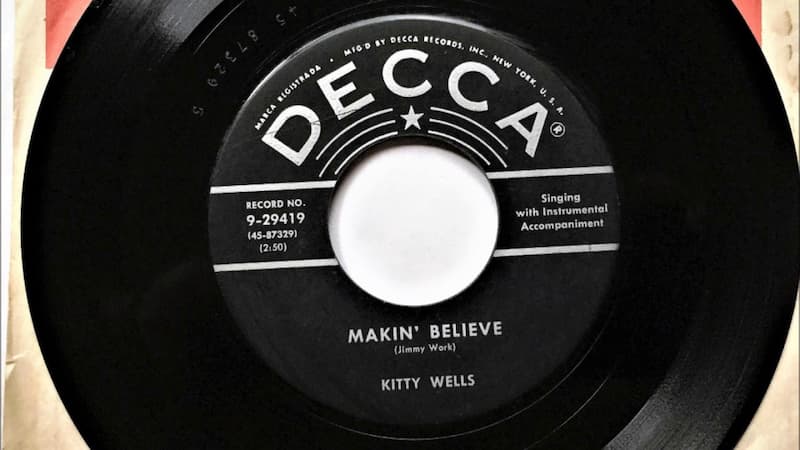
“Making Believe,” written by Jimmy Work, entered the country music landscape in early 1955 and became closely associated with Kitty Wells through her recording that same year. Work, born in Akron, Ohio, in 1924 and raised from age two on a farm in Dukedom, Tennessee, near the Kentucky border, had spent years balancing factory work in Michigan’s automotive plants with nightclub performances and songwriting. He released his own version of the song as a single on Dot Records in February 1955; it reached number five on Billboard’s country jukebox charts. Wells recorded her take on January 15, 1955, at the Bradley Studio in Nashville under producer Paul Cohen for Decca Records. The single, catalog number 29419 and backed with “Whose Shoulder Will You Cry On,” appeared in March 1955.
Wells’ version climbed to number two on the Billboard country charts and remained there for fifteen consecutive weeks, a mark that still stands as the longest stay in the runner-up position without reaching the top. It was held off number one by Webb Pierce’s “In the Jailhouse Now,” which occupied the summit for twenty-one weeks. The recording later appeared on her 1956 Decca album Kitty Wells’ Country Hit Parade (DL 8293), widely regarded as one of the earliest full-length LPs issued by a female country artist and a collection of her early hits.
The song itself is a straightforward ballad of unresolved heartbreak. The narrator continues to daydream that a former lover still cares, even while acknowledging that the relationship is finished and “you’ll never be mine.” Work is said to have completed the lyric in a short time, drawing from personal experience of lost romance during his years of factory shifts and club dates in the North. His original recording was quickly overshadowed once Wells’ version gained radio play, a common occurrence in the mid-1950s when covers often outpaced the songwriter’s own release.
By 1955 Wells, born Ellen Muriel Deason in Nashville in 1919, had already broken new ground as the first solo female singer to reach number one on the country charts with “It Wasn’t God Who Made Honky Tonk Angels” three years earlier. Married to Johnnie Wright since 1937 and performing under a stage name drawn from an old folk ballad, she had become the dominant female voice in the genre, regularly placing singles in the top ten while few other women received consistent airplay. “Making Believe” fit the restrained, emotionally direct style that defined her records of the period.
The song’s afterlife proved extensive. Emmylou Harris returned it to the country top ten in 1977, while Merle Haggard, Dolly Parton, Johnny Cash, Ray Charles, and many others recorded their own versions over the decades. Wells’ 1955 track also found a place on the soundtrack of the 1988 film Mississippi Burning. Work himself largely left full-time performing by the late 1950s, returned to Dukedom, worked as a millwright, and continued writing occasionally until his death in 2018 at age ninety-four. The recording remains one of the clearest examples of how a simple, well-crafted country song could travel from a songwriter’s modest circumstances to lasting presence on the charts and beyond.
Video
Lyric
Make believe that we’re happy (Make believe that we’re happy)
Just pretend that it’s true (Just pretend that it’s true)
Make believe you have me, I’ll make believe I have you
We’ll make believe ’til we can make it come true
You belong to another (You belong to another)
I belong to someone too (I belong to someone too)
But they can’t seem to see that our love just has to be
We’ll make believe ’til we can make it come true
Maybe someday up above (Maybe someday up above)
We’ll understand our kind of love (We’ll understand our kind of love)
We know our love like ours is real (I know just the way you feel)
We’ll make believe ’til we can make it come true
Make believe that we’re happy (Make believe that we’re happy)
Just pretend that it’s true (Just pretend that it’s true)
Make believe you have me, I’ll make believe I have you
We’ll make believe ’til we can make it come true