About The Song
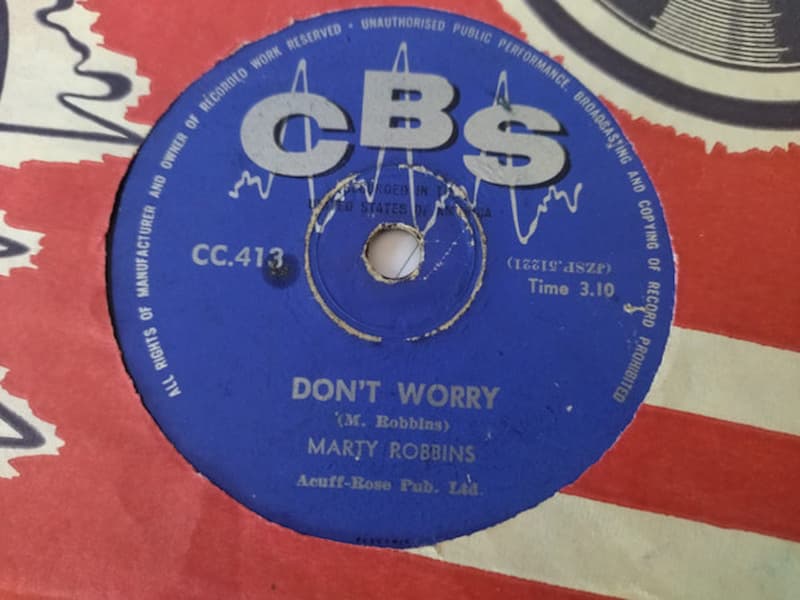
“Don’t Worry” is a country ballad written and recorded by Marty Robbins and released as a single in February 1961. The track was recorded in 1960 at Bradley Studios in Nashville and was issued by Columbia Records with the B-side “Like All the Other Times.” It was included on Robbins’ compilation release More Greatest Hits and became one of the most commercially successful singles of his career, notable both for its chart performance and for a distinctive studio effect that later drew attention from musicians and engineers.
Musically the song is structured as a mid-tempo country-pop ballad built to foreground Robbins’s warm baritone and the melodic hook. Instrumentation is economical: acoustic and electric guitars, steady rhythm, and subtle backing vocal parts provide support while keeping the vocal line central. The arrangement is concise and radio-friendly, with a clearly stated chorus and a short instrumental bridge that accentuates the song’s emotional core without resorting to ornamentation.
Lyrically, “Don’t Worry” addresses the aftermath of a relationship and the narrator’s attempt to acknowledge pain while insisting on resilience. The words are plainspoken and conversational rather than ornate, presenting lines that balance vulnerability and a pragmatic acceptance of lost love. That direct verbal approach—short images, repeating refrain, no elaborate metaphor—helped the song connect with both country audiences and broader pop listeners in the early 1960s.
The recording session produced an accidental but historically notable guitar sound. During the instrumental break session guitarist Grady Martin was tracked through a faulty mixing-channel setup that generated an unusual distorted tone on his Danelectro six-string bass. Robbins and producer Don Law elected to keep the take; the effect contributed a raw, electric edge to the bridge and is often cited as an early instance of fuzz-style distortion on a major commercial recording. That happenstance later influenced the development and marketing of fuzz devices in popular music.
Commercially, “Don’t Worry” was a major crossover hit. It became Marty Robbins’s seventh number-one on the country chart, holding the top country position for an extended run, and it also crossed over to the pop market where it reached the top five of the Billboard Hot 100. The single’s broad radio play helped sustain Robbins’s visibility at a time when country artists increasingly sought mainstream exposure and it remains one of his best-remembered non-western singles.
The song has been covered by a number of artists in subsequent decades, and it has appeared on numerous Robbins compilations and reissues. Later performers such as Holly Dunn, LeAnn Rimes and Jimmie Dale Gilmore have recorded their own versions, testifying to the composition’s adaptability across voices and production styles. On many anthologies “Don’t Worry” is presented alongside Robbins’s narrative ballads and western songs as an example of his versatility as a singer-songwriter.
In retrospective terms the track is notable for two overlapping reasons: its strong commercial showing as a crossover country-pop single and its role in early studio experimentation with electric-guitar tone. As a Robbins composition it exemplifies his economical songwriting and melodic sense; as a recording it demonstrates how an unplanned studio moment can become part of a song’s character and its place in music history. The result is a compact, durable single that remains part of Marty Robbins’s core catalog.
Video
Lyric
Don’t worry ’bout me, it’s all over now
Though I may be blue, I’ll manage somehow
Love can’t be explained, can’t be controlled
One day it’s warm, next day it’s cold
Don’t pity me, ’cause I’m feelin’ blue
Don’t be ashamed, it might have been you
Oh-oh-oh-oh, love, kiss me one time, then go, love
I’ll understand, don’t worry ’bout me
Sweet, sweet, sweet love, I want you to be
As happy as I, when you loved me
I’ll never forget you, your sweet memory
It’s all over now, don’t worry ’bout me
When one heart tells, one heart, one heart goodbye
One heart is free, one heart will cry
Oh-oh-oh-oh, sweet, sweet baby sweet, baby sweet
It’s alright, don’t worry ’bout me