About The Song
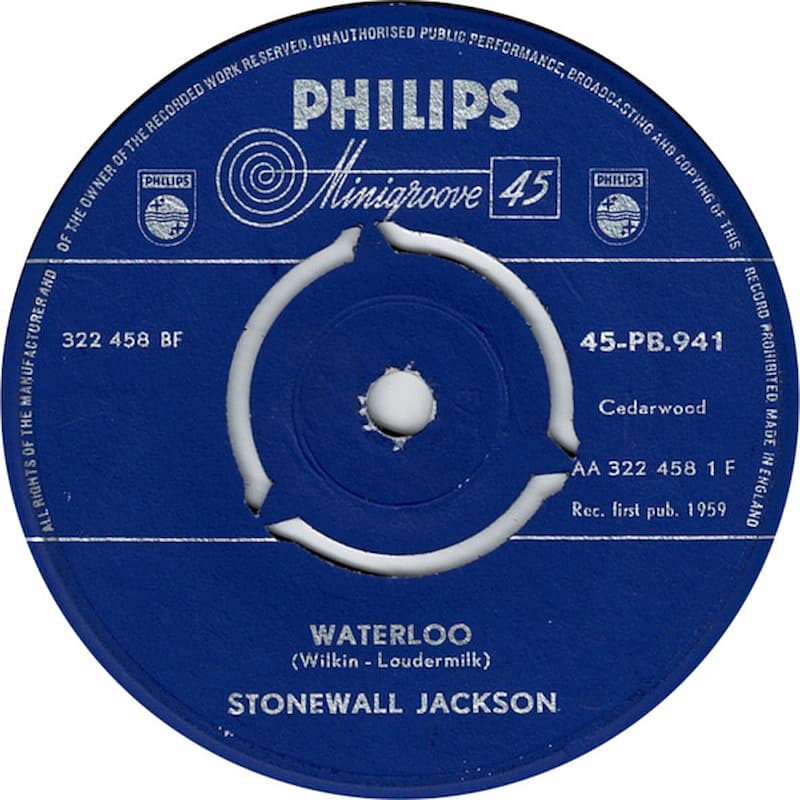
In the spring of 1959, country radio found itself humming a tune that mixed history, folklore, and a wry sense of inevitable comeuppance. Stonewall Jackson’s “Waterloo,” released as a Columbia single on May 4 with “Smoke Along the Track” on the B-side, quickly became the biggest record of his career. It spent five weeks at number one on the Billboard Hot Country & Western chart, crossed over to peak at number four on the Hot 100 (his only top-forty pop hit), reached number three on the Cash Box Top 100, and even charted at number 24 in the United Kingdom. The single sold more than a million copies and earned a gold disc. By October it anchored his debut album, The Dynamic Stonewall Jackson.
The song had been written the previous year by two rising Nashville craftsmen, John D. Loudermilk and Marijohn Wilkin. One evening in a writing room, Loudermilk sat with his guitar, complaining that nothing was coming. The conversation turned to the old expression “meeting your Waterloo,” a phrase that had entered everyday English after Napoleon’s final defeat in 1815. From that spark the pair built a simple, memorable structure: a repeating chorus that warns “everybody has to meet his Waterloo,” and three short verses that name the moment of downfall for three very different figures.
First comes Adam in the Garden, tempted by the apple and undone by the devil’s spite. Next is “Little General Napoleon of France,” who “tried to conquer the world but lost his pants” at the battle that gave the song its title. Finally there is Tom Dooley, the North Carolina mountaineer whose true-crime ballad was already familiar to listeners; in this telling he kills his unfaithful lover and ends up swinging from a tree. Each story ends with the same dry observation: that is where he met his Waterloo. The refrain returns like a village elder shaking his head—“Every puppy has his day / Everybody has to pay.”
Jackson recorded the track on February 6, 1959, under producer Don Law. The arrangement stayed lean and straightforward, letting the singer’s clear baritone carry the moral without excess ornament. Coming right after his near-miss with George Jones’s “Life to Go,” which had climbed to number two on the country chart, “Waterloo” felt like the logical next step—an upbeat yet cautionary tale that radio programmers and jukebox operators both embraced. Its crossover success brought Jackson national television exposure and confirmed that a country record could still speak plainly to a wider audience in the late 1950s.
The phrase itself had been circulating for a century before the songwriters claimed it, but Loudermilk and Wilkin gave it a fresh, almost playful currency. Later generations would hear the same historical echo in other songs, yet Jackson’s version remains the one that turned an old battlefield into everyday American vernacular. For a few months in 1959 it sat at the top of the country charts while quietly reminding everyone, from the Garden of Eden to the hills of North Carolina, that the bill always comes due.
Video
Lyric
Waterloo Waterloo
Where will you meet your Waterloo?
Every puppy has his day
Everybody has to pay
Everybody has to meet his Waterloo
Now old Adam
Was the first in history
With an apple
He was tempted and deceived
Just for spite
The devil made him take a bite
And that’s where old Adam
Met his Waterloo
Waterloo Waterloo
Where will you meet your Waterloo?
Every puppy has his day
Everybody has to pay
Everybody has to meet his Waterloo
Little General Napoleon of France
Tried to conquer the world
But lost his pants
Met defeat
Known as Bonaparte’s Retreat
And that’s when Napoleon
Met his Waterloo
Waterloo Waterloo
Where will you meet your Waterloo?
Every puppy has his day
Everybody has to pay
Everybody has to meet his Waterloo
Now a feller
Whose darling proved untrue
Took her life
But he lost his too
Now he swings where the little birdie sings
And that’s where Tom Dooley
Met his Waterloo
Waterloo Waterloo
Where will you meet your Waterloo?
Every puppy has his day
Everybody has to pay
Everybody has to meet his Waterloo