About The Song
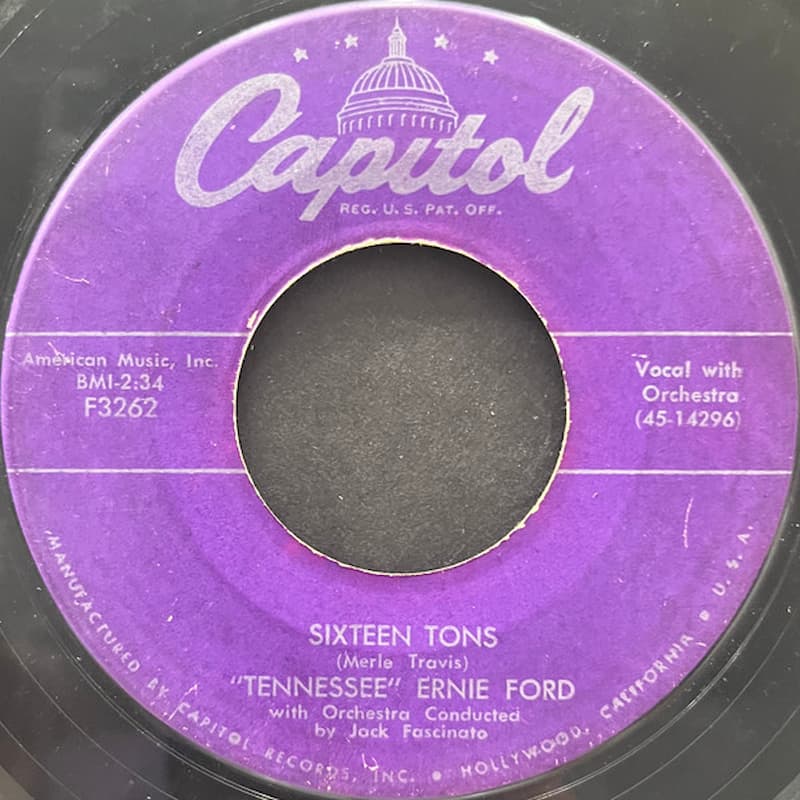
“Sixteen Tons” was written by Merle Travis in the mid-1940s, drawing on the experiences of his coal-mining family in Kentucky. Travis first recorded the song in 1946. Nearly a decade later, Tennessee Ernie Ford cut his version on September 20, 1955, at Capitol Studios in Hollywood. Intended as the B-side to “You Don’t Have to Be a Baby to Cry,” the track featured a sparse arrangement highlighted by Ford’s finger snaps, which the producer left on the finished recording.
Released in October 1955, the single quickly found favor with radio stations that preferred the darker B-side. It reached number one on the Billboard country chart and remained there for ten weeks. It also topped the pop chart for multiple weeks and became one of the fastest-selling singles in Capitol Records history. Within weeks it had sold more than a million copies; by mid-December sales had passed two million. The record also reached number one in the United Kingdom.
The lyric paints a stark picture of a coal miner’s life. The singer loads sixteen tons each day only to find himself another day older and deeper in debt, ultimately owing his soul to the company store. The fatalistic tone and vivid imagery stood in sharp contrast to much of the lighter popular music of the mid-1950s, giving the song a distinctive power that resonated widely.
Ford’s deep, resonant voice and the unusual arrangement—featuring clarinet and those distinctive finger snaps—helped turn the recording into a crossover phenomenon. The success transformed Ford from a popular country and radio personality into a national star and led to his own television variety program. “Sixteen Tons” became his signature song for the rest of his career.
Travis’s original composition had already earned respect among country audiences, but Ford’s version brought the material to a far broader public. The song has since been covered by numerous artists across genres, yet Ford’s 1955 recording remains the definitive and best-known interpretation.
In 2015 the Library of Congress added Tennessee Ernie Ford’s version of “Sixteen Tons” to the National Recording Registry in recognition of its cultural and historical significance. The combination of strong songwriting, distinctive performance, and extraordinary commercial impact has kept the record among the most enduring hits of the 1950s.
Video
Lyric
Some people say a man is made out of mud
A poor man’s made out of muscle and blood
Muscle and blood and skin and bones
A mind that’s weak and a back that’s strong
You load sixteen tons, what do you get?
Another day older and deeper in debt
Saint Peter, don’t you call me ’cause I can’t go
I owe my soul to the company store
I was born one morning when the sun didn’t shine
I picked up my shovel and I walked to the mine
I loaded sixteen tons of number nine coal
And the straw boss said, “Well, a-bless my soul”
You load sixteen tons, what do you get?
Another day older and deeper in debt
Saint Peter, don’t you call me ’cause I can’t go
I owe my soul to the company store
I was born one morning, it was drizzling rain
Fighting and trouble are my middle name
I was raised in the canebrake by an old mama lion
Can’t no high-toned woman make me walk the line
You load sixteen tons, what do you get?
Another day older and deeper in debt
Saint Peter, don’t you call me ’cause I can’t go
I owe my soul to the company store
If you see me coming, better step aside
A lot of men didn’t, a lot of men died
One fist of iron, the other of steel
If the right one don’t get you, then the left one will
You load sixteen tons, what do you get?
Another day older and deeper in debt
Saint Peter, don’t you call me ’cause I can’t go
I owe my soul to the company store