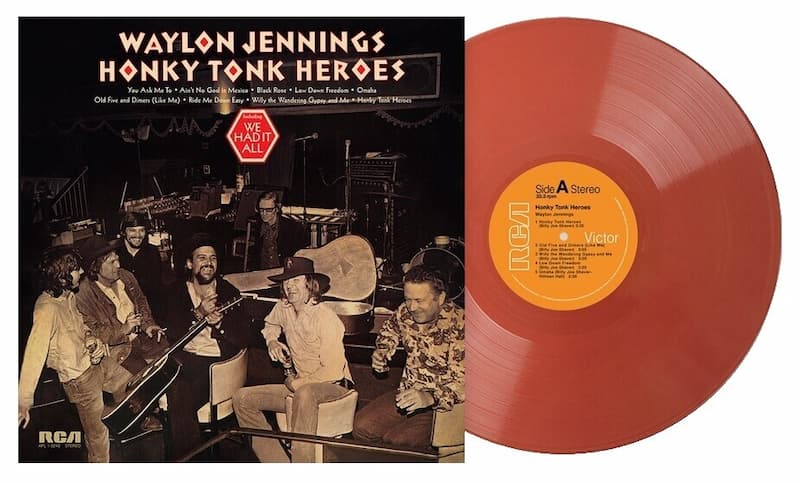
About The Song
“Honky Tonk Heroes” is the title track and centerpiece of Waylon Jennings’s 1973 album of the same name, a record widely regarded as a turning point in his career and a foundational document of the outlaw-country movement. The album is notable for its close association with songwriter Billy Joe Shaver, whose direct, hard-edged songs supply much of the record’s material. Jennings’s decision to record and prominently feature Shaver’s work marked a deliberate move away from the smooth, producer-directed Nashville sound then dominant in the industry.
Musically, the title track and the album favor a stripped-back, band-centered approach. Jennings used his own touring ensemble—the Waylors—rather than relying exclusively on Nashville session players, and arrangements emphasize driving rhythms, earthbound electric guitar, and vocal phrasing that values conversational delivery over ornamentation. The overall sonic palette is rawer and more immediate than many contemporaneous country productions, intentionally foregrounding performance energy and lyrical grit.
Lyrically, “Honky Tonk Heroes” participates in a thread of country storytelling that privileges working-class perspective, moral ambiguity, and life lived on the margins. The title and several songs on the record sketch characters shaped by honky-tonk bars, long drives, and the routines of itinerant musicians and laborers. Rather than sentimentalizing those figures, the writing tends toward plainspoken description and image-driven lines that allow listeners to project their own experience into the songs.
The recording and release of the album are frequently discussed in relation to Jennings’s efforts to secure greater creative control over his music. At a time when record labels and producers often dictated material, arrangements and session personnel, Jennings’s insistence on recording the work he and his band preferred signaled a broader assertion of artistic autonomy. This stance became a defining principle of the outlaw movement and influenced other artists who sought to reshape the business and creative expectations of mainstream country music.
Commercially and critically, the album’s impact was measured more by long-term influence than by immediate pop crossover success. While individual tracks received radio attention and the record reached audiences beyond Jennings’s existing fan base, its lasting importance lies in how it reframed what a major country album could sound like—band-driven, lyrically candid, and artist-led. Music historians and critics often point to the record as a key moment when performer priorities began to shift away from strict Nashville formulae.
Performances drawn from the album’s material became staples of Jennings’s live shows, and the title track in particular suited the direct, road-tested style he favored onstage. Because the songs were written with an eye toward real people and situations, they translated effectively in concerts: the pared-down arrangements left space for instrumental interplay and for Jennings’s telling vocal presence, which further reinforced the album’s reputation for authenticity.
Today “Honky Tonk Heroes” is remembered as both a singular album and as the namesake of a broader aesthetic shift in country music. Its title track and the collection that surrounds it remain reference points for artists and listeners interested in the intersection of songwriting, band performance and creative independence. The record’s emphasis on character-driven material, sparse production, and artist control continues to inform how many musicians approach country and Americana projects decades after its release.
Video
Lyric
Low down leaving sun
Done, did everything that needs done
Woe is me, why can I see?
I’d best be leaving well enough alone
Them neon lighting nights couldn’t stay out of fights
Keep a-haunting me in memories
Well, there’s one in every crowd, for crying out loud
Why was it always turning out to be me?
Where does it go? The good Lord only knows
Seems like it was just the other day
I was down at Green Gables, a-hawking them tables
And generally blowing all my hard-earned pay
Piano rolled blues, danced holes in my shoes
There weren’t another other way to be
For lovable losers, no-account boozers
And honky-tonk heroes like me, hey-hey
Where does it go? The good Lord only knows
Seems like it was just the other day
I was down at Green Gables, hawking them tables
Generally blowing all of my hard-earned pay
The piano rolled blues, danced holes in my shoes
There weren’t another other way to be
For lovable losers and no-account boozers
And honky-tonk heroes like me (little boogie)
Where do it go? The good Lord only knows
And seems like it was just the other day
I was down at Green Gables and hawking them tables
And generally blowing all of my hard-earned pay
Well, my piano rolled blues, danced holes in my shoes
There weren’t another other way to be
For them lovable losers and no-account boozers
And honky-tonk heroes like me, yeah