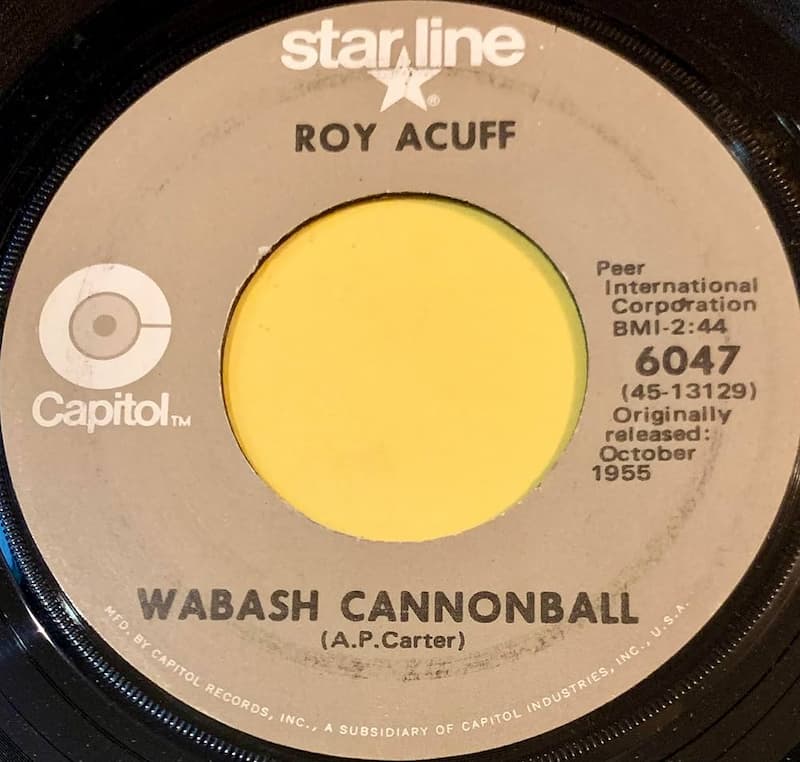
About The Song
Roy Acuff’s recording of “Wabash Cannonball” stands as one of the defining train songs in American country music. The piece traces its roots to the late nineteenth century. In 1882, J.A. Roff published “The Great Rock Island Route,” a number celebrating a mythical coast-to-coast train. William Kindt adapted the material around 1904–1905 and issued it under the title “Wabash Cannonball.” The song entered the public domain by the late 1920s, allowing A.P. Carter to rework and claim an arrangement. The Carter Family recorded it in 1929, though their version did not appear until 1932. Earlier commercial takes, including one by Hugh Cross in 1929, also circulated among hillbilly and folk performers.
Acuff and his band, then known as the Crazy Tennesseans, cut their version on October 21, 1936, in Chicago for the American Recording Company. Harmonica player Sam “Dynamite” Hatcher handled the lead vocal while Acuff supplied the distinctive steam-whistle effects he had learned during earlier work with the Louisville & Nashville Railroad. The track remained unissued for two years. When it finally appeared in 1938 on the Vocalion label, it quickly climbed the national pop charts, entering Billboard’s listings on November 24 and peaking at number 12. Sales estimates later placed the combined Acuff recordings among the handful of singles to exceed ten million physical copies worldwide.
The song’s imagery mixes real geography with pure invention. Listeners hear of a train racing from the Atlantic to the Pacific, rolling through woodlands and over mountains while hobos call out from the “jungles.” Folklore added another layer: some Depression-era itinerants spoke of a mythical “Wabash Cannonball” that arrived at a hobo’s death to carry the soul onward, a kind of folk death coach. Acuff’s arrangement kept the upbeat drive of earlier versions but substituted “Daddy Claxton” for the Carter Family’s “Daddy Cleaton.” Claxton was Acuff’s own middle name, given by his father after a visiting professor, and the change quietly personalized the lyric.
By the time the single charted, Acuff had already joined the Grand Ole Opry. Station managers asked the band to drop the “Crazy Tennesseans” moniker in favor of the more rustic Smoky Mountain Boys. “Wabash Cannonball” became a weekly requirement on the Opry stage; audiences expected both the whistle and the full-throated delivery. Acuff re-recorded the song with his own lead vocal in 1947, and the number remained a concert staple for the rest of his career. In 1949 the Wabash Railroad itself borrowed the name for its daytime Detroit-to-St. Louis express, keeping the title until Amtrak absorbed the service in 1971.
The recording’s influence stretched far beyond country circles. It appears on the Rock and Roll Hall of Fame’s list of 500 Songs That Shaped Rock and Roll, the oldest entry on that roster. In 2005 the Library of Congress added the 1936 master to the National Recording Registry. Acuff, already known as the King of Country Music, became the first living artist inducted into the Country Music Hall of Fame in 1962. The train song that began as a nineteenth-century advertising jingle for a railroad route had, through Acuff’s whistle and Hatcher’s voice, become a lasting emblem of American vernacular music.
Video
Lyric
From the great Atlantic ocean
To the wide Pacific shore
From the queen of flowing mountains
To the southbelt by the shore
She’s mighty tall and handsome
And known quite well by all
She’s the combination
Called the Wabash Cannonball
She came down from Birmingham
One cold December day
As she rolled into the station
You could hear all the people say
There’s a girl from Tennessee
She’s long and she’s tall
She came down from Birmingham
On the Wabash Cannonball
Our eastern states are dandies
So the people always say
From New York to St. Louis
And Chicago by the way
From the hills of Minnesota
Where the rippling waters fall
No changes can be taken
On the Wabash Cannonball
Here’s to Daddy Claxton
May his name forever stand
And always be remembered
‘Round the courts of Alabam
His earthly race is over
And the curtains round him fall
We’ll carry home to vic’try
On the Wabash Cannonball
Listen to the jingle
And the rumble and the roar
As she glides along the woodlands
Through the hills and by the shore
Hear the mighty rush of the engine
Hear that lonesome hobo squall
You’re travlin’ through the jungles
On the Wabash Cannonball