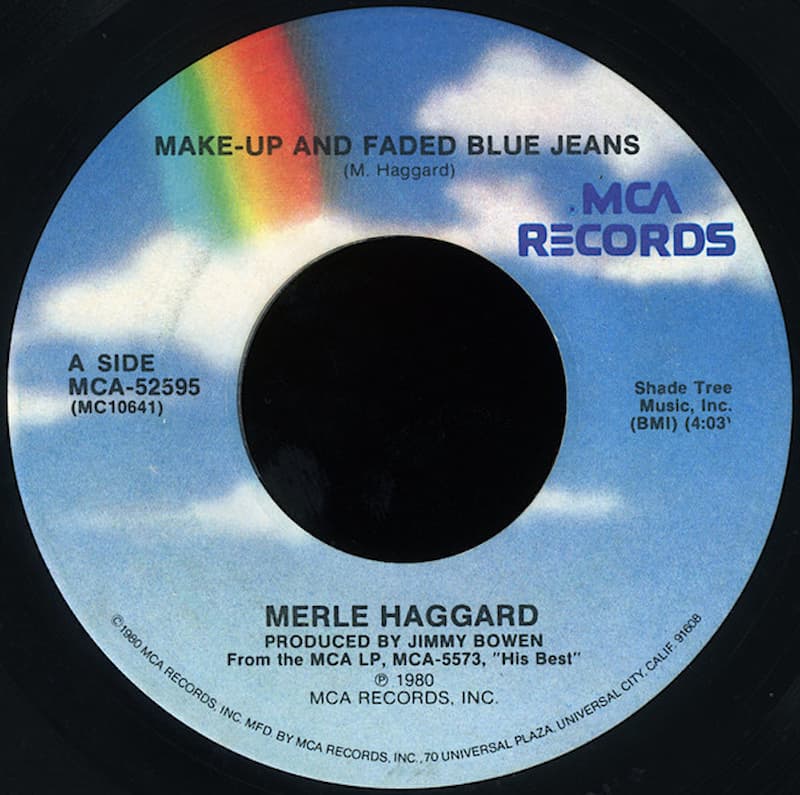
About The Song
In 1980 Merle Haggard released the album *Back to the Barrooms*, a project that found him returning to the kind of plainspoken, working-class storytelling that had defined much of his early success. One of its most quietly affecting tracks was “Make-Up and Faded Blue Jeans,” a character study written entirely by Haggard himself. The song never became a major single, but it has endured among fans for its gentle empathy and its clear-eyed portrait of a woman who has lived through plenty yet still finds a way to face the day.
The lyrics describe a woman who uses makeup and her familiar pair of faded blue jeans as a kind of armor. She’s not trying to impress anyone or recapture lost youth. She’s simply putting herself together in the way she knows how, carrying the marks of a hard life with quiet dignity. Haggard doesn’t judge or romanticize her situation. He simply observes the small, everyday rituals that help her keep moving forward, whether that means heading to work, to a bar, or simply through another ordinary day.
By the time he recorded this track, Haggard had already spent more than a decade turning the lives of ordinary people into song. He had written about prison, failed marriages, and the grind of working-class existence with unusual honesty. *Back to the Barrooms* continued that thread, but with a slightly more weathered perspective. The album’s title itself suggested a return to the honky-tonk world that had first made him famous, and “Make-Up and Faded Blue Jeans” fit perfectly into that atmosphere — a song about resilience that never asks for pity.
What makes the track special is how little it tries to do. There are no dramatic twists or sweeping conclusions. Haggard simply sketches a woman who has learned to survive on her own terms, using whatever small comforts and routines are available to her. The faded blue jeans become a symbol of endurance rather than defeat, and the makeup becomes less about vanity and more about the simple act of showing up. It’s the kind of understated storytelling that has always been one of Haggard’s greatest strengths.
The song also reflects the broader spirit of the album, which balanced rowdier barroom anthems with more reflective character pieces. While tracks like “I Think I’ll Just Stay Here and Drink” captured the escapism of honky-tonk life, “Make-Up and Faded Blue Jeans” offered a quieter counterpoint — a reminder that behind every face in the crowd is a story of endurance. Haggard’s warm, unhurried delivery makes the woman feel real rather than symbolic, someone listeners might recognize from their own lives or their own families.
Decades later the track remains a lovely example of Haggard’s ability to find dignity in ordinary struggles. It doesn’t demand attention the way some of his bigger hits do, but it rewards repeated listening with its gentle compassion. In a catalog full of anthems about working men and cultural statements, this small, empathetic portrait stands as a reminder that Haggard’s greatest gift was often his willingness to simply notice people — and to sing about them with the respect they deserved.
Video
Lyric
In downtown Modesto I was workin’ the Holiday Inn
I would stick with a gig that would last us throughout the weekend
I was singing a new song I’d wrote on the way into town
When she came in the front door and found her a place to sit down
Hey I knew right away that she like the words to my song
Cause she stared at my git guitar and followed my fingers too long
And she had the likeness of a girl I’d seen in my dreams
But lights can do wonders with make up and faded blue jeans
And the last thing I needed was somebody messin’ up my mind
So I found a hundred reasons for lookin’ her way one more time
She could cause me to sing bad and fall out of love with guitar
And blow all my chances at bein’ a big singing star
With one passin’ glance I could tell she was young for her age
Yeah she got to looking better as she got down closer to the stage
And as she sipped on her wine I knew just the kind she would be
And somehow I knew she was here to the bad things to me
And the last thing I needed…
She could cause me to sing bad…