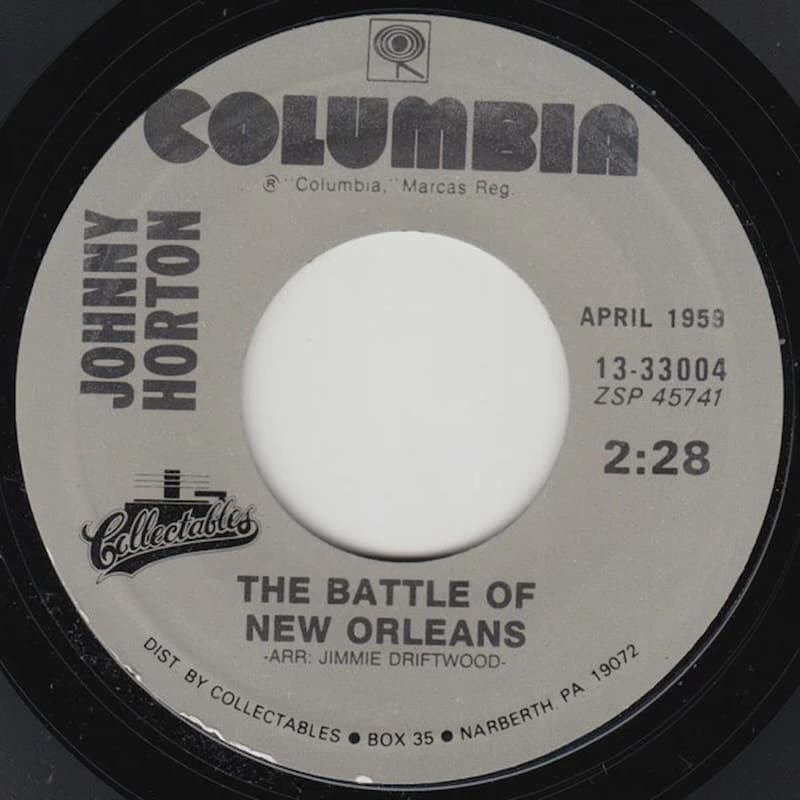
About The Song
“The Battle of New Orleans” was written by Jimmy Driftwood, an Arkansas schoolteacher who composed the song as a way to teach his students about the War of 1812. The melody draws from the traditional fiddle tune “The Eighth of January,” the date of the actual battle in 1815. Johnny Horton recorded the song in 1959 at Bradley Studios in Nashville for Columbia Records, with Don Law producing. It was released as a single on April 6, 1959, backed with “All for the Love of a Girl.”
The record became a massive crossover success. It reached number one on the Billboard Hot 100 and held the top position for six weeks. It also topped the country chart for an extended run and was ranked by Billboard as the number-one song of 1959 overall. The single performed strongly in other markets as well, reaching number one in Canada and Australia while charting in the United Kingdom. Sales exceeded one million copies.
At the second annual Grammy Awards, Horton received the award for Best Country and Western Performance, while Driftwood won Song of the Year. The recording’s lively march-like arrangement and Horton’s clear storytelling delivery helped turn a historical event into an accessible and widely appealing popular song.
The lyric recounts the American victory at New Orleans under Andrew Jackson from the perspective of ordinary soldiers. It describes the journey down the Mississippi, the preparation for battle, and the decisive defeat of the British forces in a light, narrative style rather than a solemn historical account. Horton’s version opens with a brief quotation of the opening notes of “Dixie” and closes with the sound of a marching count-off as the track fades.
By 1959 Horton had already scored country hits and was known for narrative songs with historical or regional themes. “The Battle of New Orleans” elevated him to national stardom and became his signature recording. The following year he scored another major success with “North to Alaska,” but his career was cut short when he died in a car accident in November 1960.
Within the popular music of the late 1950s, Johnny Horton’s version of “The Battle of New Orleans” stands as one of the era’s most successful story songs. Its chart dominance, award recognition, and lasting recognition as a classic of both country and popular music have kept it among the best-known recordings of its time.
Video
Lyric
In 1814 we took a little trip
Along with Colonel Jackson down the mighty Mississip’
We took a little bacon and we took a little beans
And we caught the bloody British in the town of New Orleans
We fired our guns and the British kept a-comin’
There wasn’t as many as there was a while ago
We fired once more and they began to runnin’
On down the Mississippi to the Gulf of Mexico
We looked down a river and we see’d the British come
And there must have been a hundred of ’em beatin’ on the drum
They stepped so high and they made their bugles ring
We stood behind our cotton bales and didn’t say a thing
We fired our guns and the British kept a-comin’
There wasn’t as many as there was a while ago
We fired once more and they began to runnin’
On down the Mississippi to the Gulf of Mexico
Old Hickory said, “We could take ’em by surprise
If we didn’t fire our muskets ’til we looked ’em in the eye”
We held our fire ’til we see’d their faces well
Then we opened up our squirrel guns and gave ’em
Well, we fired our guns and the British kept a-comin’
There wasn’t as many as there was a while ago
We fired once more and they began to runnin’
On down the Mississippi to the Gulf of Mexico
Yeah, they ran through the briers and they ran through the brambles
And they ran through the bushes where a rabbit couldn’t go
They ran so fast that the hounds couldn’t catch ’em
On down the Mississippi to the Gulf of Mexico
We fired our cannon ’til the barrel melted down
So we grabbed an alligator and we fought another round
We filled his head with cannonballs ‘n’ powdered his behind
And when we touched the powder off, the gator lost his mind
We fired our guns and the British kept a-comin’
There wasn’t as many as there was a while ago
We fired once more and they began to runnin’
On down the Mississippi to the Gulf of Mexico
Yeah, they ran through the briers and they ran through the brambles
And they ran through the bushes where a rabbit couldn’t go
They ran so fast that the hounds couldn’t catch ’em
On down the Mississippi to the Gulf of Mexico
Hut, two, three, four
Sound off, three, four
Hut, two, three, four
Sound off, three, four
Hut, two, three, four
Hut, two, three, four